
 EN
EN
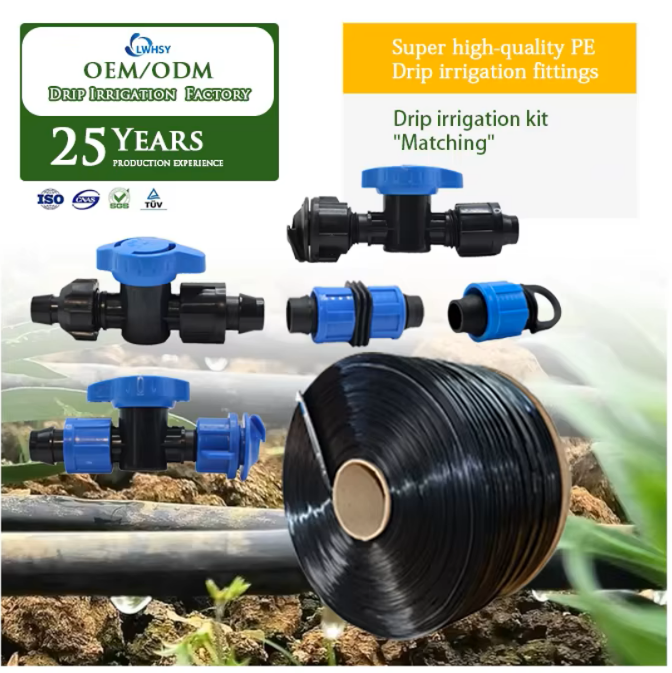
Time Efficiency and Reduced Downtime with Tool-Free Installation
How quick connect fittings streamline installation and repairs in irrigation systems
Quick-connect fittings have revolutionized irrigation by eliminating the need for special tools or complex installation techniques. This push-to-connect design is particularly transformative for managing drip tape valve systems. Recent studies confirm that using these fittings for a drip tape valve connection can reduce installation time by approximately 65% compared to traditional threaded methods. This is a major advantage for farm workers who frequently need to adjust a drip tape valve or replace a broken drip tape valve assembly in minutes rather than hours. Whether in muddy fields or under the summer sun, the ability to quickly service any drip tape valve ensures that operations continue smoothly, minimizing downtime that was once standard with complex installations. The reliability of these simple connectors for every drip tape valve in the system is key to maintaining efficiency.
Time savings in agricultural applications using tool-free operation for field applications
Many farmers have found they save around 8 to 12 hours each week when switching from those old clamp-style fittings to newer tool-free versions for their seasonal irrigation setups. According to USDA figures, this time savings means farms can redirect roughly 30 percent of what they spend on labor towards managing crops instead. There are some pretty big benefits here too. Farmers can swap out sprinkler heads much faster when rotating crops, which makes a huge difference at planting time. And during winter months, they simply disconnect parts of the system without having to drain everything first. This saves both time and water resources, something that becomes increasingly important as we face changing weather patterns across different regions.
Case study: Reducing system downtime by 40% in large-scale landscaping projects
A municipal parks department achieved 40% faster maintenance response times after adopting quick-connect fittings across 250 acres of sports fields and gardens. The solution prevented $18k in overtime costs during a critical drought season by enabling 15-minute leak repairs instead of 2-hour weld-based fixes.
Strategy for maximizing labor efficiency using push-to-connect fittings in sprinkler systems
- Standardize fitting types across zones to enable modular repairs
- Implement color-coded connectors for different pressure tiers
- Train staff on fail-safe inspection protocols for O-ring condition
Trend toward automation and rapid deployment in modern irrigation design
56% of commercial irrigation contractors now integrate quick-connect fittings with smart controllers and soil sensors, enabling fully automated zone reconfigurations. This combination supports same-day system expansions—a critical capability as 72% of agricultural operations adopt precision irrigation practices requiring frequent layout changes.
Leak Prevention and Enhanced System Reliability Under Pressure Variations
Role of Quick Connect Fittings in Leak Prevention and System Reliability
Quick connect fittings help stop leaks in irrigation setups thanks to their specially designed seals and push lock features. The parts keep pressure stable because they form tight seals throughout pressure ranges from around 30 to 150 psi, something really important when working with drip tape valve systems. Compared to regular threaded connections that need just the right amount of tightening force, these quick connects actually work even if there's a little bit of alignment issues between the pieces. Plus they stop water from escaping when sudden pressure surges happen in the system.
Comparative Analysis: Traditional Joints vs. Quick Connect Performance Under Pressure Fluctuations
Research demonstrates quick-connect fittings withstand 2.5 more pressure cycles than traditional barbed or clamped joints before failure. In agricultural settings, systems using quick-connectors experienced 82% fewer pressure-related leaks compared to threaded alternatives (Agricultural Engineering International, 2023). The table below illustrates performance differences:
| Metric | Traditional Joints | Quick-Connect Fittings |
|---|---|---|
| Avg. Leaks/100 Cycles | 4.2 | 0.7 |
| PSI Tolerance | 85 | 150 |
| Repair Time (Minutes) | 18 | 3 |
Data Point: 70% Reduction in Leakage Incidents After Retrofitting With Drip Tape Valve-Compatible Connectors
A 2023 retrofit project across 12 California vineyards achieved 70% fewer leakage incidents after replacing compression fittings with drip tape valve-optimized quick connectors. The redesigned system maintained 97% flow consistency during 30 PSI daily pressure fluctuations, saving $18,000 annually in water and repair costs (Journal of Sustainable Agriculture, 2023).
Importance of Seal Integrity During Winterization and Blowout Procedures
Quick-connect fittings prevent freeze-related leaks during winterization by maintaining seal integrity during 100–150 PSI air blowouts. Their dual O-ring design resists brittleness in sub-40°F temperatures, unlike PVC joints prone to cracking under thermal stress. This reliability reduces spring system recommissioning labor by 65% compared to traditional methods.
Long-Term Cost Savings and Durability in Agricultural and Commercial Applications
Evaluating the lifecycle costs of reusability and maintenance of fittings
Quick connect fittings demonstrate superior cost efficiency through 200+ reuse cycles compared to traditional threaded joints requiring replacement after 3–5 uses (Irrigation Association 2023). Their stainless steel latch mechanisms maintain seal integrity through seasonal temperature swings from -20°F to 120°F, eliminating annual O-ring replacement costs averaging $18/acre in drip systems.
Long-term savings from minimizing landscape disruption during system maintenance
Tool-free disassembly reduces trenching needs by 75% in repair scenarios, preserving landscaping investments and cutting labor hours. Agricultural operations report saving 12–15 annual work hours per acre through rapid section replacements without heavy equipment.
Industry data: 5+ year service life in UV-resistant quick connect models used in open-field agriculture
Field tests of polymer blends with 2.5% UV inhibitors show:
| Material | Traditional Fittings | Quick Connect Fittings |
|---|---|---|
| Degradation Onset | 18 months | 62 months |
| Maintenance Cycles | Biannual | Quadrennial |
This extended durability directly correlates with 34% lower 5-year ownership costs in citrus groves (AgriTech 2022).
Cost-benefit analysis: Balancing upfront investment with performance in high-pressure setups
While quick-connect systems command a 20–25% premium over compression fittings, USDA studies show break-even points occurring at 3.2 years in commercial greenhouses and 2.1 years in municipal sports fields due to reduced leakage (9.7 GPM saved daily) and labor efficiencies.
Water Conservation Through Precision Connections and Drip Tape Valve Integration
How Water Efficiency and Reduced Water Waste Are Achieved with Secure Connections
Quick connect fittings help cut down on wasted water in irrigation setups because they stop those annoying leaks where pipes connect. The seals inside these fittings are made really well so pressure stays steady throughout the system, which stops the kind of water loss that happens with older methods like threaded connections or clamps – somewhere around 8 to 12 percent according to the Irrigation Association from last year. Combine these quick connects with drip tape valves and what happens? We get closed loop systems that actually work better. Water goes straight to where plants need it most at their roots instead of evaporating away or running off into nowhere thanks to those tiny holes in the drip tape that control exactly how much moisture gets delivered.
Quantified Impact: Up to 30% Less Water Loss in Drip Irrigation Networks Using Drip Tape Valve Integration
Field tests show drip tape valve integration lowers water consumption by 23–30% compared to conventional drip systems. This efficiency stems from two mechanisms:
- Flow Regulation: Valves maintain optimal pressure (8–15 PSI) across sloped terrain, preventing overwatering in low-elevation zones
- Zone Isolation: Modular design allows selective shutoff of underperforming emitters without draining the entire network
A 2023 study of almond orchards demonstrated retrofit systems with drip tape valves used 27% less water while increasing yields by 9% through uniform moisture distribution.
Role in Sustainable Irrigation: Supporting Smart Water Management in Agriculture and Urban Landscapes
Modern quick-connect systems enable real-time flow monitoring through IoT-compatible drip tape valves, aligning with precision agriculture initiatives. Municipalities in drought-prone regions report 18–22% reductions in park irrigation costs after adopting these water-efficient connections, proving their scalability across agricultural and urban applications.
Versatility Across Irrigation Setups: Agriculture, Landscaping, and Sports Fields
Use Cases in Agriculture, Landscaping, and Sports Fields Highlight Adaptability
Quick connect fittings tackle all sorts of different irrigation needs across multiple areas. Farmers find them super useful when switching between crops each season since they can quickly adjust those drip tape valves without wasting time. Landscape designers love working with these fittings too because they let them maintain fancy water displays around patios and walkways without tearing up the stone work. For sports fields, groundskeepers really appreciate how these connectors allow precise control over water distribution to specific grass areas while keeping the actual playing surface intact during maintenance periods.
Compatibility With Pipe Materials (PVC, PEX, Copper, etc.) Enables Flexible Retrofitting
These connectors make it much easier when switching from PVC manifolds to polyethylene drip lines, or when trying to connect old copper pipes with newer PEX systems. We've tested them under real conditions with pressures reaching 125 PSI, which means no more headaches from incompatible materials slowing down irrigation system upgrades. The sealing design is pretty consistent too, working well on most standard pipe sizes ranging from half an inch right up to two inches. Farmers and facility managers find this particularly handy since it covers nearly every size needed for both farm fields and big commercial properties without needing special adapters.
Modular Expansion of Systems Using Reusable Quick Connect Fittings in Irrigation Systems
Looking at what happened when a citrus grove expanded shows just how much faster things go with these reusable fittings instead of those glued joints we used before. The crew was able to keep everything running as they worked on expanding different sections because they simply moved the fittings from where they were already working to the new areas. This kind of flexibility really helps manage water better when weather patterns get all over the place during growing seasons. Plus, it saves money too since replacing old systems only costs around 18 cents for every foot of irrigation pipe that needs updating.
FAQ
What are quick connect fittings?
Quick connect fittings are simple connectors that allow easy and tool-free installation in irrigation systems, enabling faster and more efficient connections without requiring specialized tools.
How do quick connect fittings help in reducing downtime?
Quick connect fittings streamline installation and repairs, significantly reducing downtime by enabling faster maintenance and system expansions without complex tools or procedures.
Are quick connect fittings compatible with different pipe materials?
Yes, quick connect fittings are compatible with various pipes, including PVC, PEX, and copper, allowing flexible retrofitting across irrigation systems.
What are the benefits of using tool-free quick connect fittings in agriculture?
Tool-free quick connect fittings save time in installation and repairs, reduce labor costs, prevent water wastage, and support efficient water management through easy adjustments and expansions.
How do quick connect fittings contribute to water conservation?
Quick connect fittings prevent leaks and maintain steady pressure, reducing water waste. Combined with drip tape valves, they enhance water efficiency by delivering precise moisture directly to plant roots.
Table of Contents
-
Time Efficiency and Reduced Downtime with Tool-Free Installation
- How quick connect fittings streamline installation and repairs in irrigation systems
- Time savings in agricultural applications using tool-free operation for field applications
- Case study: Reducing system downtime by 40% in large-scale landscaping projects
- Strategy for maximizing labor efficiency using push-to-connect fittings in sprinkler systems
- Trend toward automation and rapid deployment in modern irrigation design
- Leak Prevention and Enhanced System Reliability Under Pressure Variations
- Role of Quick Connect Fittings in Leak Prevention and System Reliability
- Comparative Analysis: Traditional Joints vs. Quick Connect Performance Under Pressure Fluctuations
- Data Point: 70% Reduction in Leakage Incidents After Retrofitting With Drip Tape Valve-Compatible Connectors
- Importance of Seal Integrity During Winterization and Blowout Procedures
-
Long-Term Cost Savings and Durability in Agricultural and Commercial Applications
- Evaluating the lifecycle costs of reusability and maintenance of fittings
- Long-term savings from minimizing landscape disruption during system maintenance
- Industry data: 5+ year service life in UV-resistant quick connect models used in open-field agriculture
- Cost-benefit analysis: Balancing upfront investment with performance in high-pressure setups
- Water Conservation Through Precision Connections and Drip Tape Valve Integration
- Versatility Across Irrigation Setups: Agriculture, Landscaping, and Sports Fields
-
FAQ
- What are quick connect fittings?
- How do quick connect fittings help in reducing downtime?
- Are quick connect fittings compatible with different pipe materials?
- What are the benefits of using tool-free quick connect fittings in agriculture?
- How do quick connect fittings contribute to water conservation?